


Y’all, the Jerard Jay Jackson case is almost tailor-made for The Subtracted because it hits one of the patterns I keep pointing people toward: a Black man dies under suspicious circumstances, law enforcement moves quickly toward a conclusion, contradictions start stacking up, and before the family gets any meaningful damn answers, evidence, timelines, and accountability start slipping through the fucking cracks.
What caught my attention wasn’t just that Jerard Jay Jackson was found hanging from a tree in Michigan. It was the mountain of inconsistencies surrounding what happened before and after his death. The people he was with told one story. Text messages suggested another. Police were called because Jerard reported a criminal incident himself. His family disputes the mental health narrative that quickly emerged. His digital wallet was reportedly used while he was missing. Then, somehow, when his family sought an independent autopsy, they were told his body had already been cremated.
Jerard Jay Jackson Belongs in The Subtracted
The Subtracted exists because too many suspicious Black deaths get reduced to a line item, a police statement, and eventually silence.
Jerard Jay Jackson belongs here because his case is filled with unanswered questions that demand public scrutiny. A Black man called police to report a criminal incident. The police responded and left after concluding no crime had occurred. Within roughly a day, that same man was dead, hanging from a tree near his rental vehicle.
Authorities moved toward a suicide determination.
The problem is that nearly every fact that surfaced afterward raised more damn questions than it answered.
And when questions multiply faster than explanations, that’s exactly when the public should pay closer attention, not less.
The North Ain’t Innocent
By now, y’all already know where I stand on this.
I’ve been out here pushing back against the fantasy that racial violence, suspicious deaths, investigative failures, and institutional indifference are somehow Southern problems. Every time a case like this lands in my hands, somebody wants to act shocked because it happened in Michigan, Illinois, New York, Minnesota, or Ohio instead of Mississippi.
I ain’t shocked.
Because the North ain’t innocent.
Never has been.
The North has spent generations benefiting from the myth that racism has a ZIP code. That if a Black person dies under suspicious circumstances in a northern state, we’re supposed to automatically have more faith in the investigation. More faith in the institutions. More faith in the official story.
I’ve covered too many cases to buy into that shit. The names change. The states change. The press conferences change. The pattern doesn’t.
A Black family is looking for answers. Authorities move quickly toward a conclusion. Contradictions start piling up. Community concerns get brushed aside. Family members are told to trust a process that somehow keeps leaving them with more questions than answers.
And now here we are again.
Not in Mississippi.
Not in Alabama.
Not in Georgia.
Michigan.
Because white supremacy has never respected state lines, and neither has institutional failure.
Jerard Jay Jackson’s case caught my attention for the same reason so many other cases have: the closer you look, the messier the story gets. The contradictions multiply. The timeline gets shakier. The explanations raise new questions. And somehow, before those questions can be answered, his body is cremated. Y’all, that really got to me.
So no, I don’t see this as an isolated case. I see it as another chapter in a pattern I’ve been documenting for a long time. The North ain’t innocent. And Jerard Jay Jackson is one more reason nobody should keep pretending otherwise.
A Timeline Full of Holes
According to available accounts, Jerard attended Electric Forest with a group of white people. At some point, he contacted police to report what he believed was a criminal incident involving members of that group.
Police responded.
No crime was found.
Then Jerard disappeared.
The white people with him later claimed he was experiencing a mental health crisis. His family rejects that characterization and says he had no documented history suggesting such a crisis.
Meanwhile, text messages reportedly show a heated disagreement among the group before Jerard left. That fucking matters because it introduces an alternative explanation for the conflict that has nothing to do with mental illness. If the narrative is that Jerard wandered off because of a mental health emergency, why do reported text messages point toward interpersonal conflict?
And why did the story seem to evolve only after he went missing?
The Mental Health Shortcut
Let’s talk about one of white America’s favorite investigative escape hatches. When a Black person dies under suspicious circumstances, suddenly everybody becomes a mental health expert.
The dead can’t speak.
The living start constructing explanations.
Case closed.
Except that’s not how evidence works. The fact that someone may have been upset, stressed, angry, frustrated, or involved in an argument is not proof they intended to die.
Fuck, I’m upset as I am writing this, but I have no intention of dying.
And contrary to what some people seem to believe, determining whether someone was suicidal is not as simple as saying they looked sad, acted withdrawn, or had a difficult day. The National Institute of Mental Health notes that potential warning signs can include things like talking about wanting to die, expressing hopelessness, giving away possessions, saying goodbye to loved ones, or making plans for death.
Yet in Jerard’s case, family members dispute the claim entirely. Festival workers stated they had seen him that morning and observed no signs suggesting suicidal behavior.
That doesn’t prove what happened.
But it does mean the public is being asked to accept a narrative that the people closest to Jerard reject. And that fucking matters.
Because once again, a Black family is saying something doesn’t add up about their own damned loved one. The person they knew best. The person they spoke to, laughed with, argued with, celebrated with, and loved.
Yet somehow their concerns are treated as less credible than narratives constructed after they’re gone by white folks who knew them for a weekend. That’s why the narrative should be examined, not blindly accepted. A claim ain’t fucking evidence. An explanation ain’t an investigation.
The Belongings Problem
One of the strangest aspects of this case involves Jerard’s belongings. Police stated that he left behind his phone and personal items. Yet family members reported that his digital wallet was used while he was missing.
If that’s accurate, investigators should be able to determine who the fuck accessed it, where it was used, and what transactions occurred.
Because those ain’t some minor details.
Those details can establish timelines. They can establish possession. They can establish movement.
Most importantly, they can establish whether the public has been given the full fucking story.
Why Were They Driving His Car?
This is the part I can’t get past, y’all. I really need you to sit with this shit.
According to family accounts, the same white people who later claimed Jerard was experiencing a mental health crisis took his phone and keys while he slept and eventually drove back to Illinois without him.
Read that again.
We’re being told Jerard was experiencing a mental health crisis.
Fine.
Then somebody needs to explain why the response was to leave him behind. Hundreds of miles from home. Without his phone. Without his keys. While other white people drove away in the car he rented.
Make that make sense.
The more I look at that sequence of events, the more questions I have! If the concern was truly Jerard’s well-being, why was he left behind? If those white people genuinely believed he was in crisis, why was he separated from the very things he would need to contact someone, get help, or get home? Why take the phone? Why take the keys? Why leave him behind?
Y’all, those ain’t wild questions. They’re the obvious ones. And reasonable people don’t hear this story and walk away with fewer questions. They walk away with a hell of a lot more.
They Cremated the Body
Y’all, this shit pissed me off.
When Jerard’s family arranged for an independent autopsy, they were reportedly informed that his body had already been cremated because no next of kin had been listed.
How?
Because that ain’t a small detail. That’s fucking evidence. That’s the question. How does that happen when family members report being in ongoing communication with authorities? How does a Black family actively seeking answers somehow become invisible when decisions are made about their loved one’s remains?
Whether that was bureaucratic incompetence, procedural failure, or something else entirely, the result is the damn same. An independent review became dramatically more difficult. And once evidence is gone, it’s gone.
Contradictions Ain’t Answers
The official narrative and the known questions continue pulling in opposite directions.
Police told the public it was suicide.
Family members heard that the investigation remained ongoing.
Friends described a mental health crisis.
Messages point toward conflict.
Police say belongings were left behind.
Family says financial activity occurred while he was missing.
None of these contradictions tell us exactly what happened to Jerard, but they destroy the notion that public concern is irrational. Investigations exist to resolve contradictions, not fucking ignore them.
Community Command Center: How We Should Classify This Case
Alright, y’all, here is the classification I recommend using:
Classification: Suspicious Death Following Conflicting Witness Accounts
Secondary classifications:
Death Following Police Contact
Contradictory Witness Statements
Disputed Mental Health Narrative
Potential Evidence Preservation Concerns
Family Seeking Independent Review
Black Death Quickly Ruled Suicide
Unresolved Timeline Discrepancies
The most important thing for the community to understand is this: You do not need to prove murder before demanding accountability. Community advocacy should focus on unanswered questions, investigative transparency, evidence preservation, timeline reconstruction, and independent review.
Stay disciplined.
Stay factual.
Stay focused on the contradictions.
The contradictions are doing enough work on their own.
Activate Jackie’s Army Pressure Campaign
Primary Ask: Full public accounting of the investigation timeline and review of all circumstances surrounding Jerard Jay Jackson’s death.
Michigan State Police: General Contact: (517) 332-2521; Public Information: www.michigan.gov/msp
Oceana County Sheriff’s Office: Phone: (231) 873-2121; Website: www.oceanasheriff.com
Oceana County Prosecutor’s Office: Phone: (231) 873-4328
Michigan Department of Civil Rights: Phone: (800) 482-3604; Website: www.michigan.gov/mdcr
Governor Gretchen Whitmer: Constituent Services: (517) 335-7858; Website: www.michigan.gov/whitmer
Sample Demand
“We are requesting full transparency regarding the investigation into the death of Jerard Jay Jackson. We are asking authorities to publicly address the contradictions in witness timelines, clarify reported digital wallet activity while Mr. Jackson was missing, explain the circumstances surrounding the cremation of his remains, and ensure that every investigative avenue has been thoroughly explored before the public is asked to accept any conclusion.”
The Real Question
The question ain’t whether authorities have a theory. The question is whether that theory survives contact with the facts.
Jerard Jay Jackson called police because he believed something criminal had happened. He vanished. He was found hanging from a tree. The people around him gave accounts that reportedly conflict with text messages. His family disputes the mental health narrative.
Questions remain about his belongings.
Questions remain about his digital wallet.
Questions remain about how his body was cremated before an independent autopsy could occur.
That’s why we’re adding Jerard Jay Jackson to The Subtracted. Because the story we’re being asked to accept and the facts we’re being shown ain’t telling the same story. And until somebody reconciles those contradictions, the questions ain’t going away.
A claim ain’t fucking evidence.
An explanation ain’t an investigation.
The Weight of The Subtracted; And Why I Keep Carrying It
The Subtracted ain’t a blog. It ain’t commentary. It ain’t content. It’s a ledger of what this country keeps taking from us, and keeping that ledger accurate costs me something every single time. Adding Nolan ain’t just another entry; it’s another weight. Another wound. Another reminder of how violently this country treats Black life and how much work it takes to document that violence honestly.
Every case means hours of digging, verifying, cross‑checking, and pulling apart contradictions these states hope nobody notices. It means reading autopsies that don’t make sense, timelines that don’t add up, statements that contradict themselves, and rulings that tell you exactly how little Black life matters to the machinery that’s supposed to protect it. It means sitting with the grief of families who will never get answers. It means absorbing trauma that ain’t mine but becomes mine because I’m the one carrying it into the light.
The Subtracted takes time. It takes energy. It takes emotional bandwidth. It takes mental health. It takes sleep. It takes peace. It takes pieces of me I don’t get back. And I keep doing it because mainstream media won’t. Because the state won’t. Because somebody needs to build a public record of the Black people this country keeps subtracting. If I don’t write these stories, they disappear, and Mississippi counts on that.
I keep The Subtracted free because these stories need to stay visible. They need to stay accessible. They need to stay in the public eye. But free doesn’t mean costless. Free means I’m paying the cost so you don’t have to. And that cost is getting heavier.
If you want this work to continue; if you want Jerard’s story documented, archived, and refused; if you want these cases investigated, mapped, and exposed; if you want The Subtracted to stay alive, I need support. Not because I’m fragile. Not because I’m overwhelmed. But because this work is bigger than one person, and the toll is real.
I’m going to drop a link to The Subtracted. I’m also adding a “Support the Project” button. Separate. Clear. Intentional.
Because The Subtracted is the work, and supporting it is how you help carry the weight.
Rest in Power, King
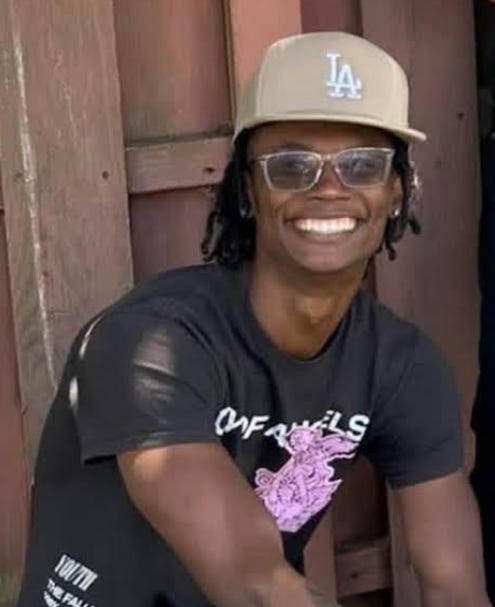
Jerard Jay Jackson should be here. That’s the part I can’t get past. Every conversation about suicide determinations, witness statements, and police conclusions eventually runs into the same fucking reality: a Black man is dead.
Authorities want the public to focus on their conclusion. I keep coming back to the damn questions. I keep coming back to the fact that Jerard called police to report a criminal incident before he died. I keep coming back to the conflicting timelines. I keep coming back to reports that his digital wallet was used while he was missing. And I keep coming back to the fact that when his family tried to secure an independent autopsy, they were told his body had already been cremated.
That’s what these racist ass institutions always count on.
Time.
Distance.
Fatigue.
The belief that eventually people will stop asking questions and settle for whatever explanation they’re given.
Not this time.
Jerard’s family deserves answers. The public deserves transparency. And nobody gets to declare this conversation over just because they’ve reached a conclusion they’re comfortable defending. So keep talking about Jerard Jay Jackson. Keep documenting the contradictions. Keep asking the questions that remain unanswered.
Most importantly, keep his name alive in your communities, command centers, and pressure campaigns. Because a Black man should not disappear behind an official ruling. And he damn sure should not be remembered only through the story authorities want to tell about him.
What you said about a lot of people thinking it’s a southern problem was very true. It’s also very thought provoking to see someone writing about how mental health issues can be used as a method to insinuate that the person provoked the violence, and how it’s also used as an excuse to accuse the crime victim of having a help seeking deficit.
This smells like Nolan Wells but on land. There is a rented boat, not a rented boat. No phone, no digital wallet and his white friends decide to leave a “distraught” Black man suffering a mental crisis in unfamiliar surroundings.