


I don’t add Black people to The Subtracted simply because their deaths were ruled suspicious. I add them when I see the same pattern repeat.
A Black person dies. Authorities arrive at a conclusion. Critical questions remain unanswered. The family struggles to get information. Transparency becomes harder to obtain than the official narrative. And somehow the burden shifts from investigators explaining their conclusions to the public explaining why they’re still asking questions.
That’s why we’re talking about Gloria Bambo. Not because I can tell you exactly what happened to her.
I can’t.
Neither can most of the people defending the official ruling. What I can tell you is that her case contains many of the same fucking contradictions, information gaps, and transparency failures that we’ve seen throughout The Subtracted.
Twenty-year-old Gloria Bambo, a South African citizen living in McKinney, Texas, was found hanging in the garage of the home she shared with a 19-year-old white male roommate on July 12, 2020. Almost immediately, police settled on a conclusion.
Suicide.
If you’ve been following the Subtracted, you already know why that ain’t the end of the story. Because The Subtracted has never been about rejecting official conclusions just because we don’t like them. It’s about examining whether those conclusions can withstand scrutiny. It’s about asking whether evidence was tested or assumptions were accepted. It’s about identifying the moments where transparency stops, and trust begins.
When I looked at Gloria’s case, all the warning signs that define The Subtracted were right there.
That’s why she belongs here.
A Body Doesn’t Just Disappear Into A House
One of the first contradictions in this case is also one of the most fucking obvious. Gloria reportedly went missing on July 9. They didn't find her until July 12. That means she could have been hanging in that garage for up to three days.
Three days.
Read that again.
Three days.
And during that period, maintenance workers reportedly entered the property to perform repairs. So let’s ask the question nobody seems eager to answer. How does a young Black woman remain hanging inside a garage for days while people are coming and going from the residence?
What areas were accessed?
Who entered the garage?
Who didn’t?
Were timelines independently verified?
Were statements challenged?
Were assumptions tested?
Because that’s what investigations are supposed to do. They’re supposed to eliminate questions. Instead, years later, people are still asking them. And when basic questions survive this long, that ain’t a sign of public paranoia. It’s a sign that confidence was never fully earned.
The White Roommate Knew Exactly What Police Needed To Hear
Now let’s talk about something that keeps showing up in these cases. The dead Black person can’t tell their side of the story. So somebody else does it for them. In Gloria’s case, that somebody appears to have been her 19-year-old white male roommate.
According to reports, he told investigators Gloria was estranged from her family. He said she had lost her job. He said she struggled with mental health issues. So, a Black woman ends up dead, and a white man suddenly becomes the primary narrator of her life story. So, instead of asking whether those claims were independently verified, people are expected to accept them?
That should make everybody uncomfortable. Because investigators are supposed to fucking investigate. A roommate ain’t a psychiatrist. A roommate ain’t a forensic pathologist. A roommate ain’t an autopsy report. A roommate ain’t her fucking family. A roommate shouldn’t become the foundation of a death determination. Especially when you add the racial dynamics.
Yet somehow, the things he reportedly said fit neatly into the story authorities were already telling. And that’s where the mental health conversation starts to feel conveniently real. Because I’ve noticed something while covering these cases. Mental health gets used like a fucking magic word. The moment it enters the conversation, the public is expected to stop asking questions.
Well, she had mental health struggles.
Well, she lost her job.
Well, she was going through things.
Case closed.
Except no.
That’s not how evidence works. Having depression doesn’t prove suicide. Having anxiety doesn’t prove suicide. Losing a job doesn’t prove suicide. Fighting with family doesn’t prove suicide.
Those are circumstances.
They are not conclusions.
And while everybody was focused on the mental health narrative, the real question got pushed aside. Were the claims about Gloria independently verified, or were they accepted simply because they supported the conclusion authorities had already reached?
Trust Us. Just Don’t Ask To See The Evidence.
This is where the entire thing starts falling apart for me. Authorities insist there was no evidence contradicting the suicide determination.
Cool.
Show us.
Release the full autopsy. Release the crime scene photographs. Release the handwriting analysis connected to the note. Release the records that supposedly support the conclusion.
Because here’s what I never understand about these cases. If the evidence is overwhelming, transparency should strengthen the ruling. It shouldn’t threaten it. But over and over again, the public gets told the same thing.
Trust us. The evidence supports our conclusion.
No, you can’t see most of it.
No, we won’t provide complete transparency.
No, we don’t think you need additional answers.
Y’all, that ain’t accountability. That’s authority demanding faith.
And Black communities have centuries of experience teaching us exactly what happens when we’re expected to trust these white-supremacy-ridden institutions without evidence.
Texas Has Earned Black Folks’ Suspicion
Every time Black folks question one of these cases, somebody from these white-ass institutions rolls in demanding trust.
Trust the police.
Trust the investigators.
Trust the process.
Trust the ruling.
FUCK YOU
They never want to talk about why that trust disappeared in the first place. Texas didn’t earn a reputation for racial justice. Texas earned a reputation for racial violence. Historians have documented hundreds of lynchings throughout the state’s history. Researchers at the University of Texas note that there were 492 documented lynchings in Texas between 1882 and 1930.
The Equal Justice Initiative’s research found that racial terror lynchings were not isolated incidents carried out by a handful of extremists. They functioned as tools of racial control and often occurred with the tolerance of institutions that were supposed to protect Black communities.
Black people didn't wake up one morning and decide not to trust official explanations. That distrust was earned. It was earned through generations of racist institutions telling Black communities everything was handled while refusing to answer obvious questions. When officials say, “Trust us,” they’re speaking to communities that have heard that line before.
And history has taught us that trust without transparency is fucking dangerous.
This Ain’t An Isolated Incident
I keep covering these cases because the pattern is impossible to ignore. A Black person is found dead. Authorities arrive at a conclusion quickly. A narrative forms almost immediately. Questions remain unanswered. Critical records stay hidden. Black families spend years fighting for information. The public gets accused of being unreasonable for wanting transparency.
And somehow the people demanding evidence become the problem. Not the missing information. Not the unanswered questions. Not the lack of transparency. The Black people asking for accountability.
That’s the pattern. And Gloria Bambo’s case fits far too comfortably inside it.
Let’s Talk Community Command Center Classification
Alright, here is the classification I recommend using: Suspicious Death With Transparency Deficits. This classification does not declare homicide. It does not claim investigators are lying. It does not conclude suicide was impossible. Remember, we need to be strategic. It does, however, recognize that significant questions remain unanswered because transparency remains limited.
Indicators include:
A rapid suicide determination.
Heavy reliance on narrative information reportedly supplied by a white roommate.
Questions surrounding Gloria’s timeline before discovery.
Limited public access to investigative records.
Family and community concerns that remain unresolved.
A refusal to release information that could strengthen confidence in the official findings.
Y’all need to be actively monitoring this type of case. Not because we know what happened. Because we don’t.
Activate Jackie’s Army Pressure Campaign
The goal ain’t to prove a theory. The goal is to demand transparency. Gloria Bambo’s family and community deserve evidence-backed answers, not conclusions protected by fucking secrecy. If authorities are confident in their findings, full transparency shouldn't be a fucking problem.
Contact the McKinney Police Department
Demand:
Release of all legally releasable records related to Gloria Bambo’s death.
Clarification regarding the timeline between July 9 and July 12, 2020.
Disclosure of whether a formal handwriting analysis was conducted and, if so, the findings.
An explanation of how investigators verified witness statements and timelines.
McKinney Police Department Records Division
2200 Taylor Burk Dr., McKinney, TX 75071
Email: Records@McKinneyTexas.org
Phone: (972) 547-2820
Non-Emergency Line: (972) 547-2700
Contact the Collin County District Attorney
Demand:
An independent review of the investigation.
Clarification regarding what evidence supports the suicide determination.
Greater transparency around investigative records that remain unavailable to the public.
Collin County District Attorney’s Office
2100 Bloomdale Road, Suite 100
McKinney, TX 75071
Phone: (972) 548-4323
Contact McKinney Elected Officials
Ask city leadership why transparency remains an issue in a case that has generated ongoing public concern.
Mayor Bill Cox
Phone: (972) 547-7507
McKinney City Hall
401 E. Virginia Street
McKinney, TX 75069
General City Phone: (972) 547-7500
Pressure Campaign Objectives
Jackie’s Army should remain focused on four demands:
Release the full autopsy documentation.
Release all releasable crime scene records and photographs.
Release documentation regarding any handwriting analysis connected to the reported note.
Release a complete public timeline showing who entered the residence, when they entered, what they observed, and how investigators verified those accounts.
We ain’t asking people to assume what happened to Gloria. We’re asking why the public is still being denied the information necessary to evaluate the investigation for themselves. Because transparency doesn’t weaken legitimate conclusions. Transparency proves them. So what is the fucking problem?
The Weight of The Subtracted; And Why I Keep Carrying It
The Subtracted ain’t a blog. It ain’t commentary. It ain’t content. It’s a ledger of what this country keeps taking from us, and keeping that ledger accurate costs me something every single time. Adding Nolan ain’t just another entry; it’s another weight. Another wound. Another reminder of how violently this country treats Black life and how much work it takes to document that violence honestly.
Every case means hours of digging, verifying, cross‑checking, and pulling apart contradictions these states hope nobody notices. It means reading autopsies that don’t make sense, timelines that don’t add up, statements that contradict themselves, and rulings that tell you exactly how little Black life matters to the machinery that’s supposed to protect it. It means sitting with the grief of families who will never get answers. It means absorbing trauma that ain’t mine but becomes mine because I’m the one carrying it into the light.
The Subtracted takes time. It takes energy. It takes emotional bandwidth. It takes mental health. It takes sleep. It takes peace. It takes pieces of me I don’t get back. And I keep doing it because mainstream media won’t. Because the state won’t. Because somebody needs to build a public record of the Black people this country keeps subtracting. If I don’t write these stories, they disappear, and Mississippi counts on that.
I keep The Subtracted free because these stories need to stay visible. They need to stay accessible. They need to stay in the public eye. But free doesn’t mean costless. Free means I’m paying the cost so you don’t have to. And that cost is getting heavier.
If you want this work to continue; if you want Gloria’s story documented, archived, and refused; if you want these cases investigated, mapped, and exposed; if you want The Subtracted to stay alive, I need support. Not because I’m fragile. Not because I’m overwhelmed. But because this work is bigger than one person, and the toll is real.
I’m going to drop a link to The Subtracted. I’m also adding a “Support the Project” button. Separate. Clear. Intentional.
Because The Subtracted is the work, and supporting it is how you help carry the weight.
Rest in Power, Queen
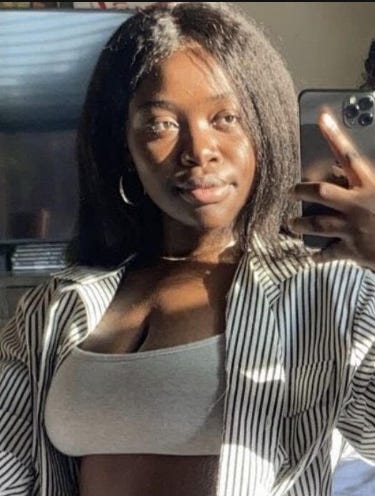
Gloria Bambo should be here. That’s the part I can’t get past. Every conversation about suicide determinations, witness statements, and police conclusions eventually runs into the same reality: a 20-year-old Black woman is dead.
McKinney officials want the public to focus on their conclusion. I keep coming back to the damn questions. I keep coming back to the three days Gloria was reportedly missing before she was found. I keep coming back to the maintenance workers who reportedly entered the property during that time. And I keep coming back to the mental health narrative reportedly supplied by her 19-year-old white roommate while key records remain unavailable to the public.
That’s what these racist ass institutions count on.
Time.
Distance.
Fatigue.
The belief that people will eventually stop asking questions and accept the answer they're given.
Not this time.
Gloria’s family deserves transparency. The public deserves transparency. And officials don’t get to declare the conversation over simply because they’ve reached a conclusion they’re comfortable with.
So keep talking about Gloria Bambo. Keep documenting her case. Keep asking the questions that remain unanswered. Most importantly, keep her name alive in your communities, command centers, and pressure campaigns.
Because a Black woman should not disappear behind an official ruling. And she damn sure should not be remembered only through the story authorities want to tell about her.

I remembered this case too. This occurred right in the midst of the George Floyd protests. Police were ramped up to killing us and stopped investigating our suspicious deaths. I always believed her roommate SAerd her and killed her before she told authorities.
Beautifully written yet again. I of course will always share your work and support your integrity. Nothing but respect and appreciation 🩵